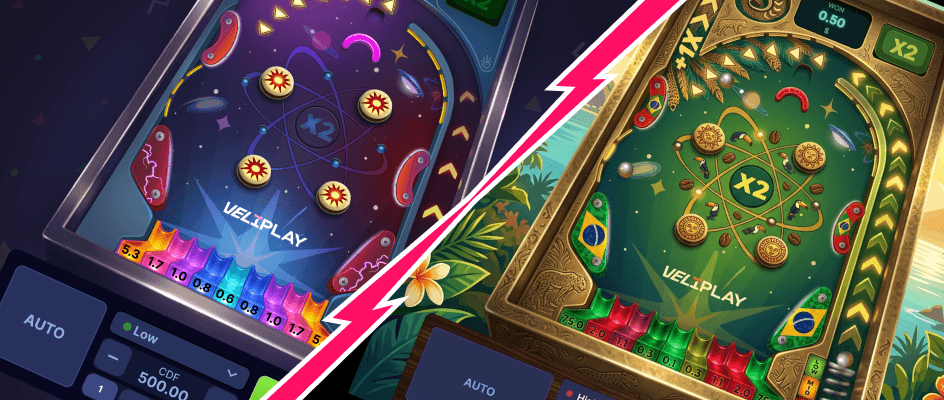
Pinball Rush LATAM localisation is not about translating a few labels and calling the job done. It is about making the game feel familiar, readable, and ready to play from the first second. In a region where mobile-first behaviour shapes first-bet decisions fast, recognition drives performance.
LATAM does not reward generic casino content.
Instead, it rewards recognition.
That matters for Pinball Rush.
The game already carries a strong advantage: the core board feels familiar. The motion is easy to follow. The ball moves. Tension builds. The board reacts. The result feels immediate.
As a result, Pinball Rush opens up strong localisation potential for Latin America.
Pinball Rush LATAM localisation is not a box to tick. Rather, it is what turns a game from visible into playable.
For operators heading into LATAM, that difference shapes performance. Pinball Rush fits the region because it combines familiar visual logic with fast, readable gameplay. In markets where players decide quickly and mobile experience carries real weight, that matters.
Familiarity is a conversion tool
Many games enter new markets with the same mistake.
They translate text, swap a banner, and stop there.
However, real localisation starts earlier. It starts with first-bet logic.
Pinball Rush already carries cues that lower friction: a familiar interface, readable motion, and a faster path to first bet. These are not cosmetic details. Instead, they shape whether the game feels instantly playable or slightly distant.
In mobile-first environments, the first seconds decide whether a player stays or drops. As a result, if the game looks readable and feels culturally legible, the entry barrier drops.
That is where an instant game starts to earn its place in a portfolio.
For a casino game provider, this is the difference between launching content and launching something that actually lands.
LATAM is a region, not a single market
Operators need discipline here.
LATAM is a commercial label, not a product design strategy.
Brazil needs Brazilian Portuguese. Meanwhile, Spanish-first markets need their own language layer. Vocabulary, tone, and payment expectations differ across Mexico, Colombia, Chile, and Argentina. So a single regional wrapper is not enough.
The real opportunity is not “Pinball Rush for LATAM.”
Rather, it is Pinball Rush with a localisation system built for LATAM.
One game framework with market-ready layers. Not one static version forced across the region.
That matters for any game development company working across multiple target markets, but it matters even more in crash and instant games, where speed, recognition, and low friction shape performance from the first touch.
Why Pinball Rush is a strong localisation candidate
Not every title deserves deep market adaptation.
Some games need too much explanation. Some rely too heavily on niche references. Some mechanics lose clarity once they move into a different context.
Pinball Rush starts from a stronger base.
It uses a mechanic players already recognise.
The game shows motion clearly.
It also creates instant visual tension.
Most importantly, it supports fast first-bet logic.
That gives localisation more room to work. In other words, the job is not to rescue the concept. The job is to remove whatever slows recognition in each market.
That is a strong position for a casino game development company entering or expanding across LATAM.
How to localise Pinball Rush for LATAM
The strongest localisation path is to localise what players notice first.
Language
Brazilian Portuguese should never sit underneath a broader Spanish content layer. It needs its own UX copy, its own onboarding phrasing, and its own promotional tone.
The same applies across Spanish-speaking markets. Here too, direct wording works better than overexplaining. Likewise, sharp labels work better than long instructions.
If the language feels native, the game feels easier to trust.
That matters in any crash casino game, but especially in one built around speed and reaction.
Visual framing
Pinball is already a recognisable mechanic. As a result, the game has a strong head start.
Localisation can push that advantage further through region-specific launch packs, stronger market-facing visuals, and clearer promotional framing around motion, momentum, and immediate play value.
The goal is not to redesign the game for every country. Instead, the goal is to make recognition happen faster.
Player-entry logic
This is where localisation moves beyond translation. More importantly, it starts shaping first-bet behaviour.
In mobile-first markets, too much explanation slows the round before it starts. A good localised flow reduces hesitation. It keeps labels sharp, action points immediate, and visual cues easy to process.
Pinball Rush already has the right foundation for that. The game does not need heavier onboarding. Instead, it needs cleaner market-specific entry.
That is how a crash game keeps first contact tight and first bet closer.
Operator-facing assets
Localisation should not stop at the player layer.
It should also shape how operators receive, position, and launch the title.
That includes market-ready promo copy, localised thumbnails, CRM messaging, and launch materials that help partners explain the game fast.
In practice, a casino game provider does not win regional traction through the product alone. It wins through how quickly partners can understand it, pitch it, and deploy it.
That is especially true in competitive markets where similar content fights for the same attention.
Performance design over decoration
Localisation is often treated like polish.
In reality, it is not polish. It is performance design.
A translated game is not always a localised game. Likewise, a localised game is not always a market-fit game.
The difference sits in the details.
Does the language sound native.
Does the interface reduce hesitation.
Does the game explain itself fast.
Do the launch assets match how the market scans, reacts, and decides.
For Pinball Rush, this is where the real LATAM opportunity sits.
Instead of pitching another instant title, operators can position a localisable game with familiar visual logic, fast comprehension, and stronger regional fit. That is a sharper commercial story for any game development studio focused on crash games and instant games.
Why this matters now
As VeliPlay heads into LATAM-facing conversations, Pinball Rush gives operators a practical angle.
The game does not need to change what makes it work.
Instead, it needs localisation that lets each market recognise it faster.
That is the difference between visibility and traction.
More importantly, it is the difference between launching a title and building one into the portfolio.
Launch what players recognise faster.
Industry coverage already points in the same direction.
Coverage from G3 Newswire, European Gaming, HIPTHER, and Asia Gaming Brief strengthens the Pinball Rush launch story across industry media. The publications frame the game around rebound-driven physics, momentum-based gameplay, mobile-first design, and a structure that moves beyond standard crash presentation. For operators, that external coverage adds credibility to the product story and reinforces Pinball Rush as a differentiated instant title with recognisable logic and stronger commercial talking points.